about us
Background of Conference
The current global public health landscape is situated within a multidimensional state of uncertainty, often described as a turbulent world. We are not only dealing with the residual impacts of the pandemic, but also with the escalating climate crisis that exacerbates disease patterns, geopolitical instability that disrupts medical supply chains, and demographic transitions that increase the burden of non communicable diseases. Within this turbulence, the vulnerability of health systems across countries has become increasingly exposed, revealing significant inequities in access to healthcare services, both between countries and within populations.
The World Health Organization and global leaders have emphasized the urgent need to shift from reactive responses toward the development of resilient health systems. Resilience is not merely defined by the ability of a system to withstand shocks, but also by its capacity to adapt and transform in order to ensure the continuity of services for all segments of the population without exception. Preparedness and equity are essential prerequisites for achieving the Sustainable Development Goals, particularly Goal 3, which focuses on health and well being.

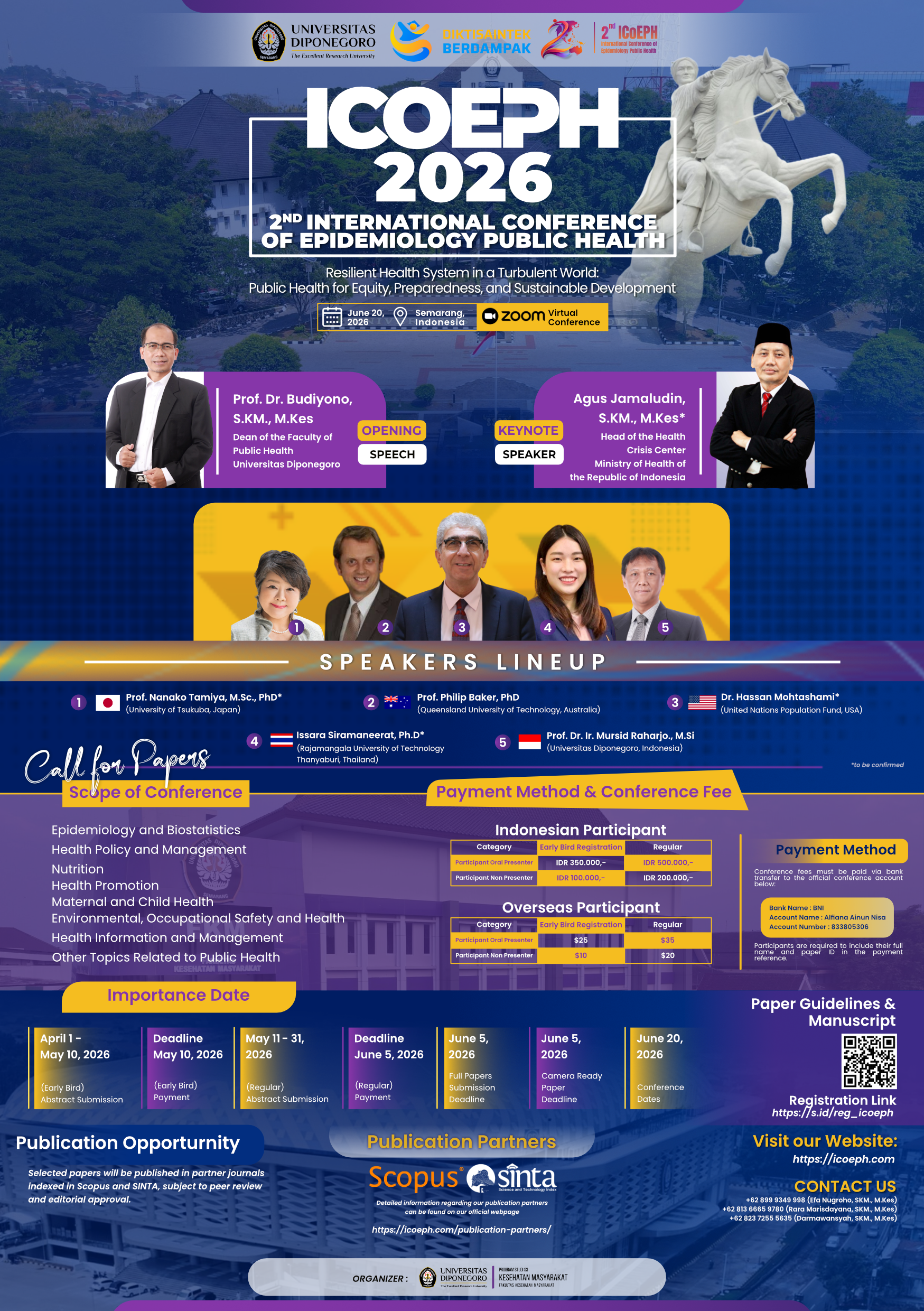
In response to these complex challenges, the 2nd International Conference of Epidemiology Public Health (ICOEPH) adopts the theme “Resilient Health Systems in a Turbulent World: Public Health for Equity, Preparedness, and Sustainable Development.” This event is designed to address the urgent need for adaptive and inclusive public health strategies.
The primary focus of this year’s conference is to explore how modern epidemiological principles, evidence based health policies, and social innovations can be integrated to strengthen the core pillars of health systems. Discussions will be directed toward closing health inequity gaps, enhancing early detection and outbreak response systems, and ensuring that health development aligns with environmental and economic sustainability principles.
As a continuation of the successful implementation of the previous conference, the 2nd ICOEPH in 2026 will once again serve as a strategic platform for academics, health practitioners, epidemiologists, policymakers, and the private sector. This forum aims to facilitate the exchange of up to date knowledge, disseminate cutting edge research findings, and foster strong cross sector collaborations to build a more equitable and resilient global health future.

Based on this background, the Faculty of Public Health at Universitas Diponegoro will organize the 2nd International Conference of Epidemiology Public Health (ICOEPH) as a concrete contribution of higher education institutions to the transformation of global health systems.
Objectives:
- To serve as a global scientific forum for academics, health practitioners, epidemiologists, policymakers, and stakeholders to exchange strategic ideas on strengthening resilient health systems.
- To examine current public health challenges in the context of global turbulence and to formulate comprehensive preparedness strategies.
- To promote the development of health policies oriented toward equity and inclusiveness, ensuring that no population is left behind in accessing healthcare services.
- To facilitate the dissemination of epidemiological research findings and public health innovations that support the achievement of the Sustainable Development Goals.
- To strengthen cross sectoral and international collaboration in building adaptive response mechanisms to future health crises.
Benefits:
- To expand academic and professional networking opportunities for participants, fostering multidisciplinary research collaborations and the initiation of global health programs.
- To enhance scientific contributions through the publication of research findings in reputable international journals, accredited national journals, and international conference proceedings.
- To improve participants’ knowledge and capacity in implementing public health strategies that emphasize system resilience, equitable access, and sustainability.
Expected Outputs of the Event
The outputs of this event include the formulation of strategic recommendations compiled into a policy recommendation document aimed at addressing challenges related to equity, outbreak preparedness, and the development of resilient health systems in the context of global turbulence.
In addition, this conference will generate scientific publications derived from conference materials and oral presentation articles, which will be published in an International Proceedings with an ISBN. Selected papers will have the opportunity to be published in Scopus indexed international journals, as well as in accredited national journals (SINTA).